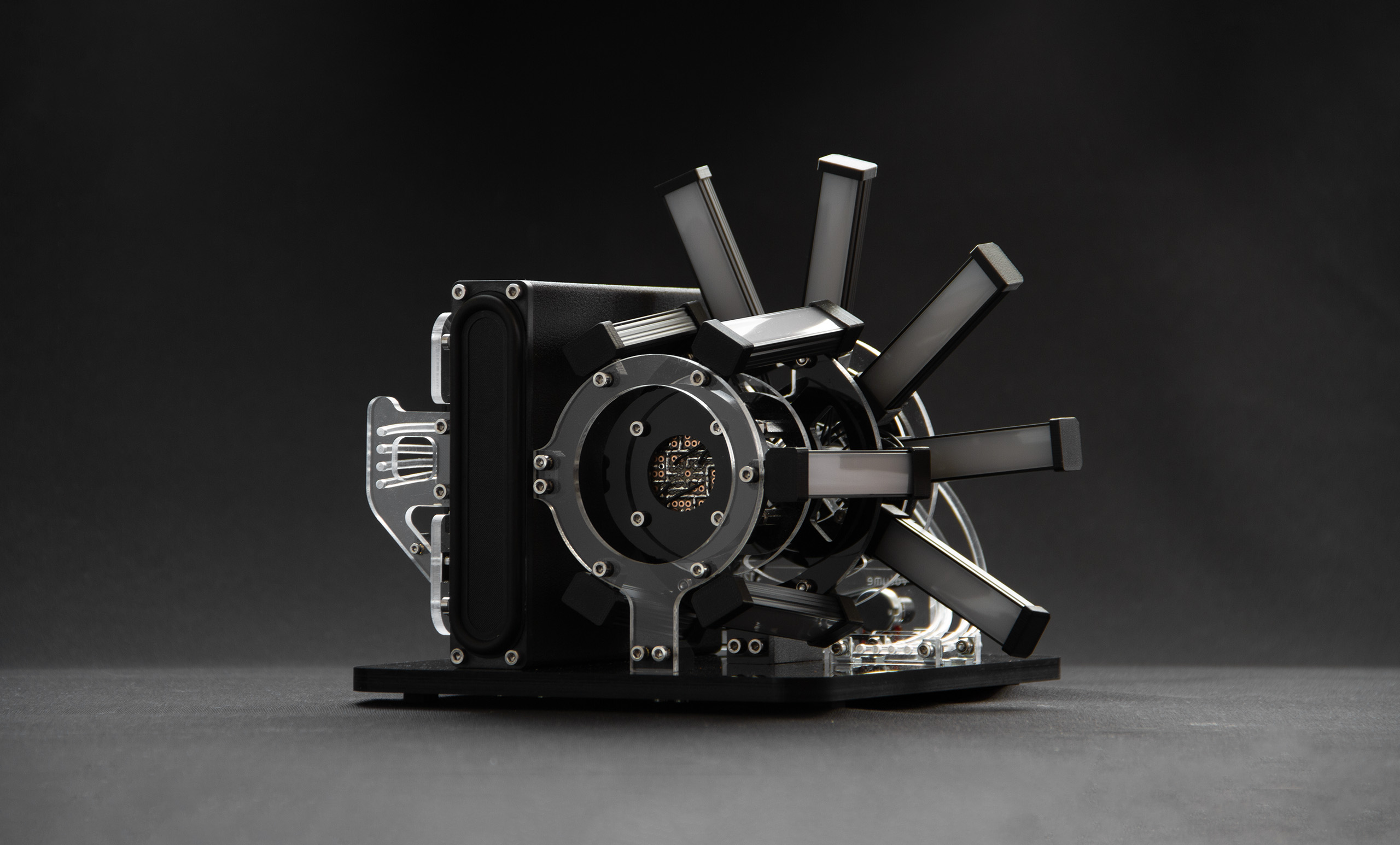
radial dispersion of coalesced sediments
sound and light sculpture, 2026
+12Vdc 1.5A, external power supply
180mm x 210mm x 200mm
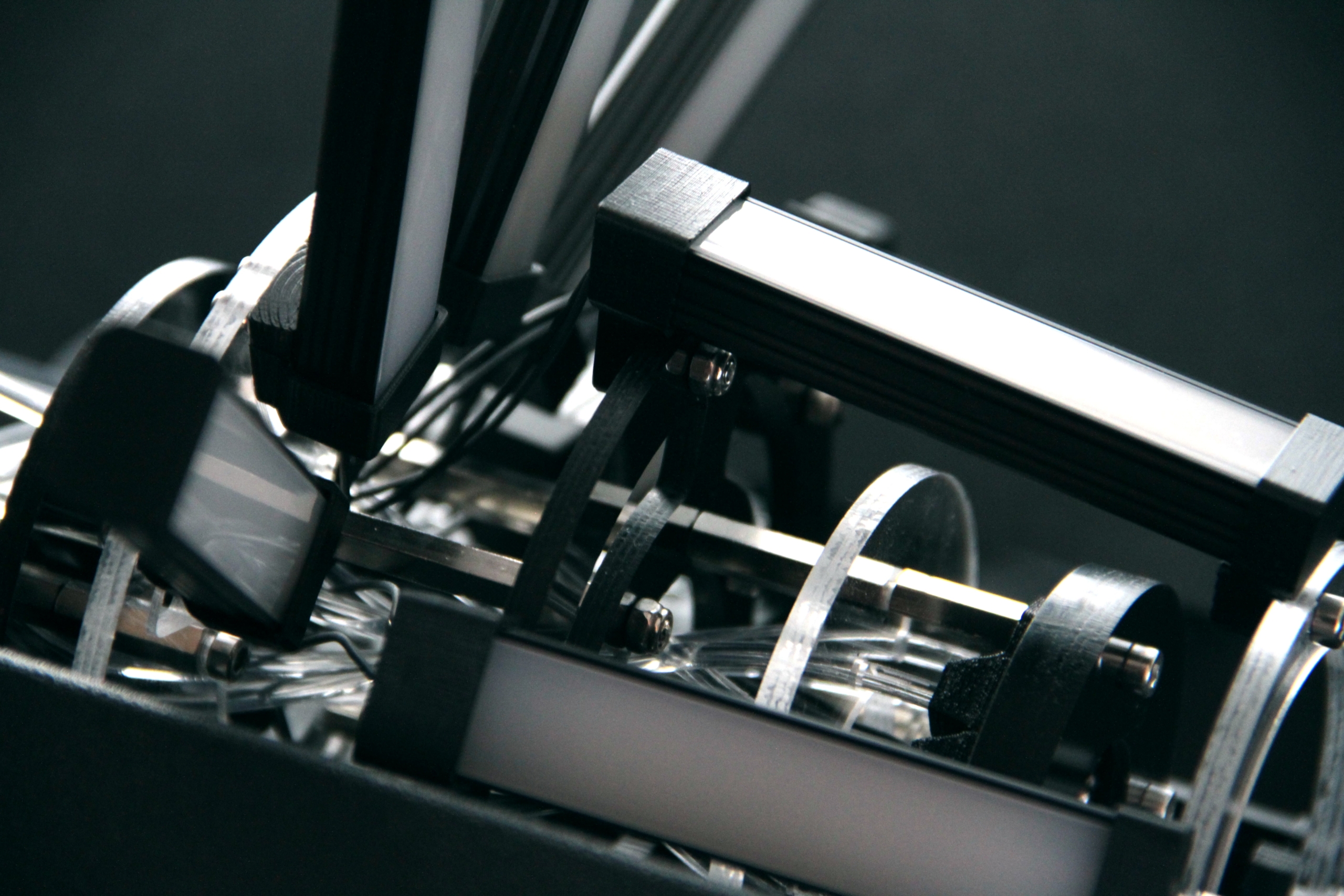
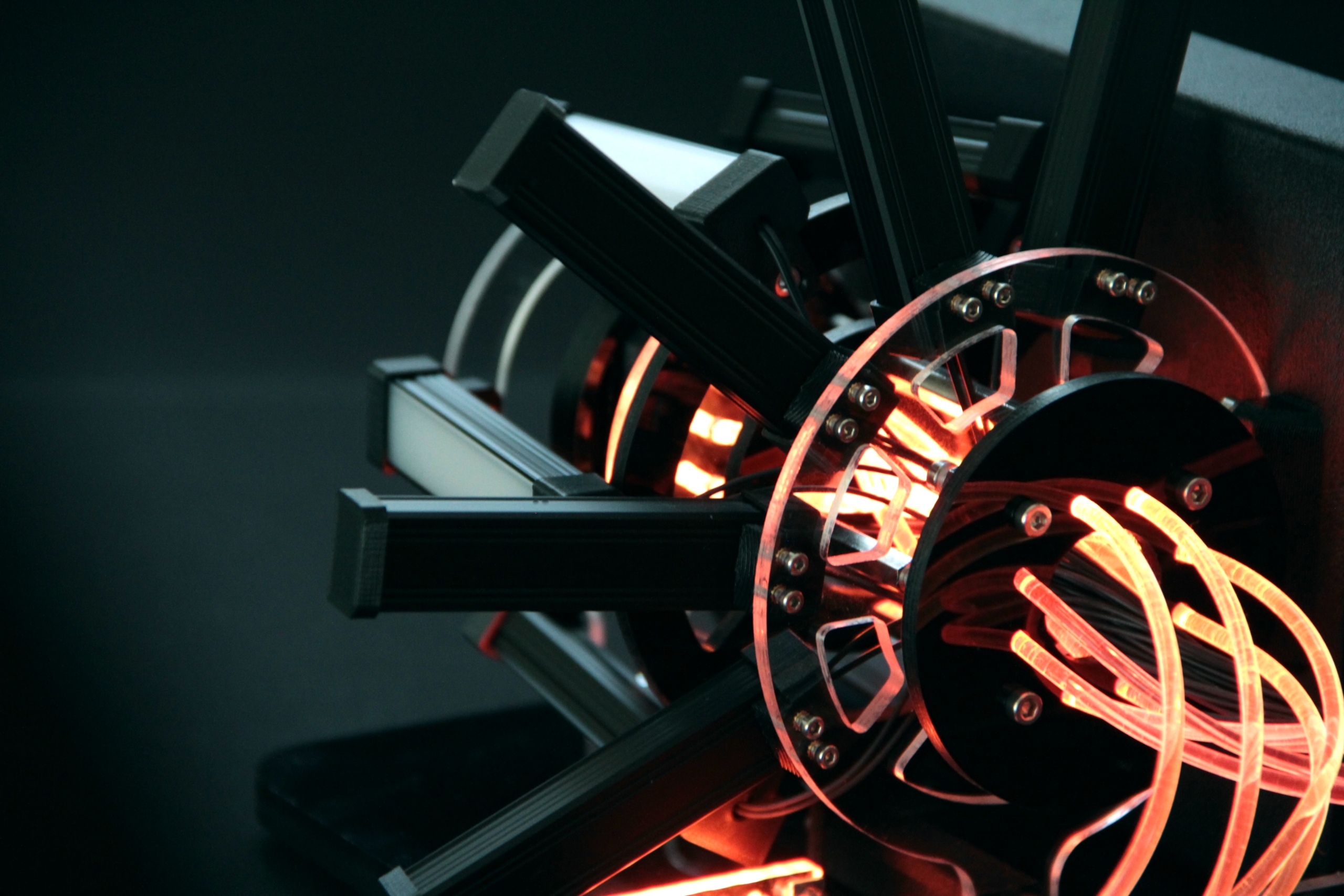
Based on the Karplus-Strong algorithm – a physical modelling synthesis method developed by Kevin Karplus and Alex Strong in the early 80s – radial dispersion of coalesced sediments is a sound and light sculpture conceived from the idea of monophonic audio as a vertical architecture. Single-channel sound could be described as an inherently upright structure built without the counterforts of the ‘3D soundscape’ found in stereo audio, existing instead along a spectral vertical line stretching from the lowest to the highest perceivable frequencies. Karplus–Strong synthesis uses an initial burst of wideband noise (a ‘pluck’) to excite a delay line whose delay time determines the fundamental frequency. The delayed signal is filtered and fed back into the delay line, with the filtering progressively attenuating higher frequencies and mimicking the energy loss of a plucked string over time. The wideband noise (‘pluck’) is essentially a tall, vertical structure which is condensed into a horizontal line over time (a ‘pitch’). In this work the resulting sound of this process, the coalesced sediments of a wideband noise, is dispersed radially along a horizontal axis comprising ten aluminium LED profiles and light pipes, extending the sound centrifugally from the central axis of its vertical origin.